Every day your disconnected system runs, you're losing margin.
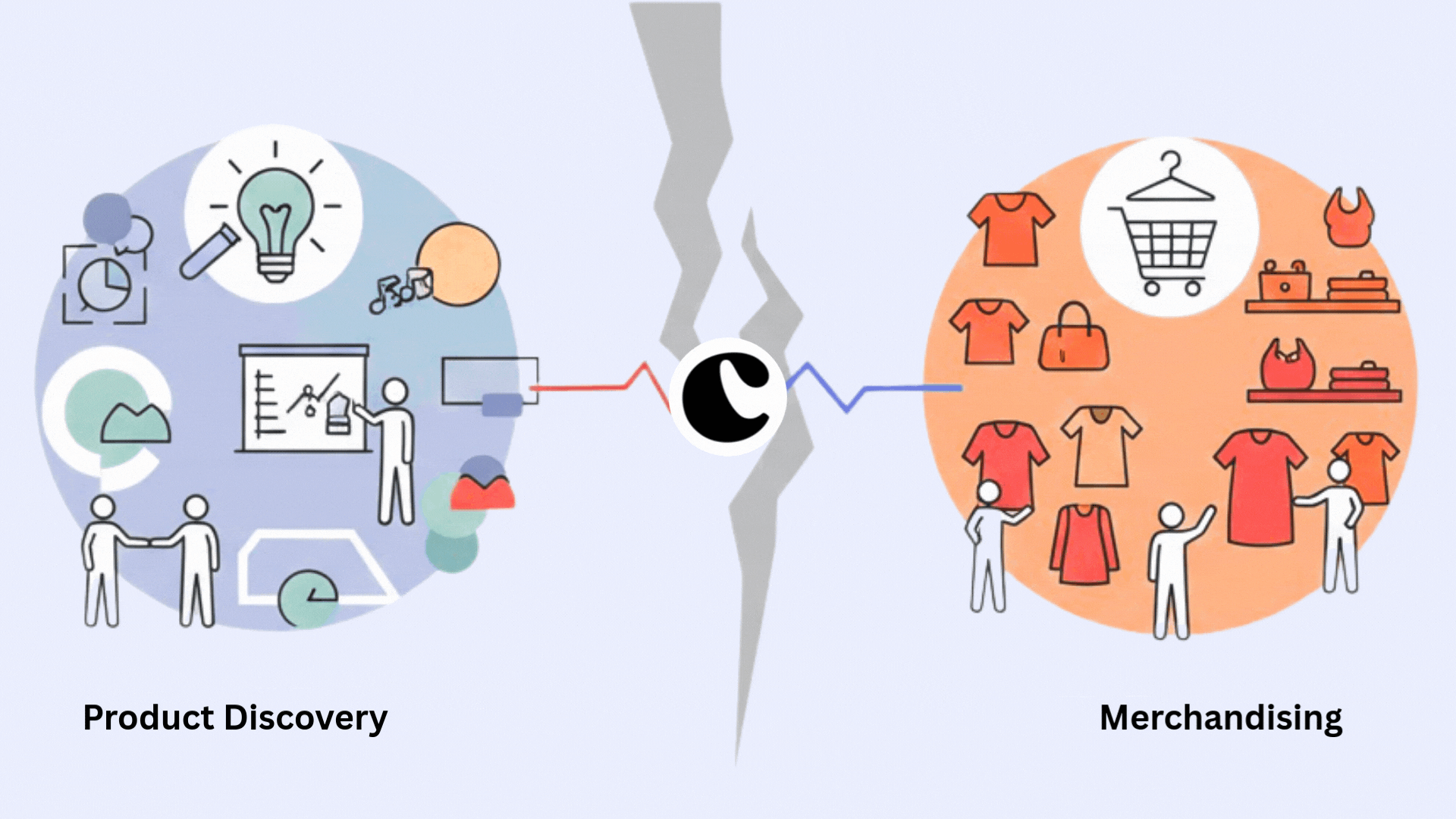
Not from theft, markdowns, and shrinkage but from friction. The kind that happens when your PLM, PIM, ERP, and marketplaces don't communicate. When product data sits in one system and pricing lives in another. When your merchandising team makes decisions based on incomplete information.
This is an operational and margin problem, not a technology or integration issue.
And it shows up in ways most retailers ignore: late product launches, allocation errors, unnecessary markdowns, SKU duplication, and merchandising decisions made with stale data.
This costs an average of 3-7% in lost margin annually for mid-sized retailers operating disconnected operations.
When your systems don't connect, your teams create workarounds.
They build spreadsheets. Send emails with attachments. Make phone calls to check stock levels.
Your marketing team wants to run a flash sale on a new product line? They need correct product information and pricing.
Whereas your PLM has the latest specs. Your PIM has outdated descriptions. Your ERP has the cost data. Your marketplace listings display different prices.
So someone manually pulls data from each system. Creates a spreadsheet. Cross-check and reference everything. By the time marketing gets proper information, the competitive window has closed.
They push the promotion anyway with incomplete data. Customers get confused by inconsistent product details. Returns spike. Your team spends hours fixing listings across platforms.
All because your ERP, PLM, PIM, and marketplaces didn't cooperate well enough.
According to the 2024 State of Retail Media report, retailers with fully integrated data systems have seen a 43.2% improvement in customer satisfaction scores, driven largely by enhanced inventory accuracy and seamless data flows.
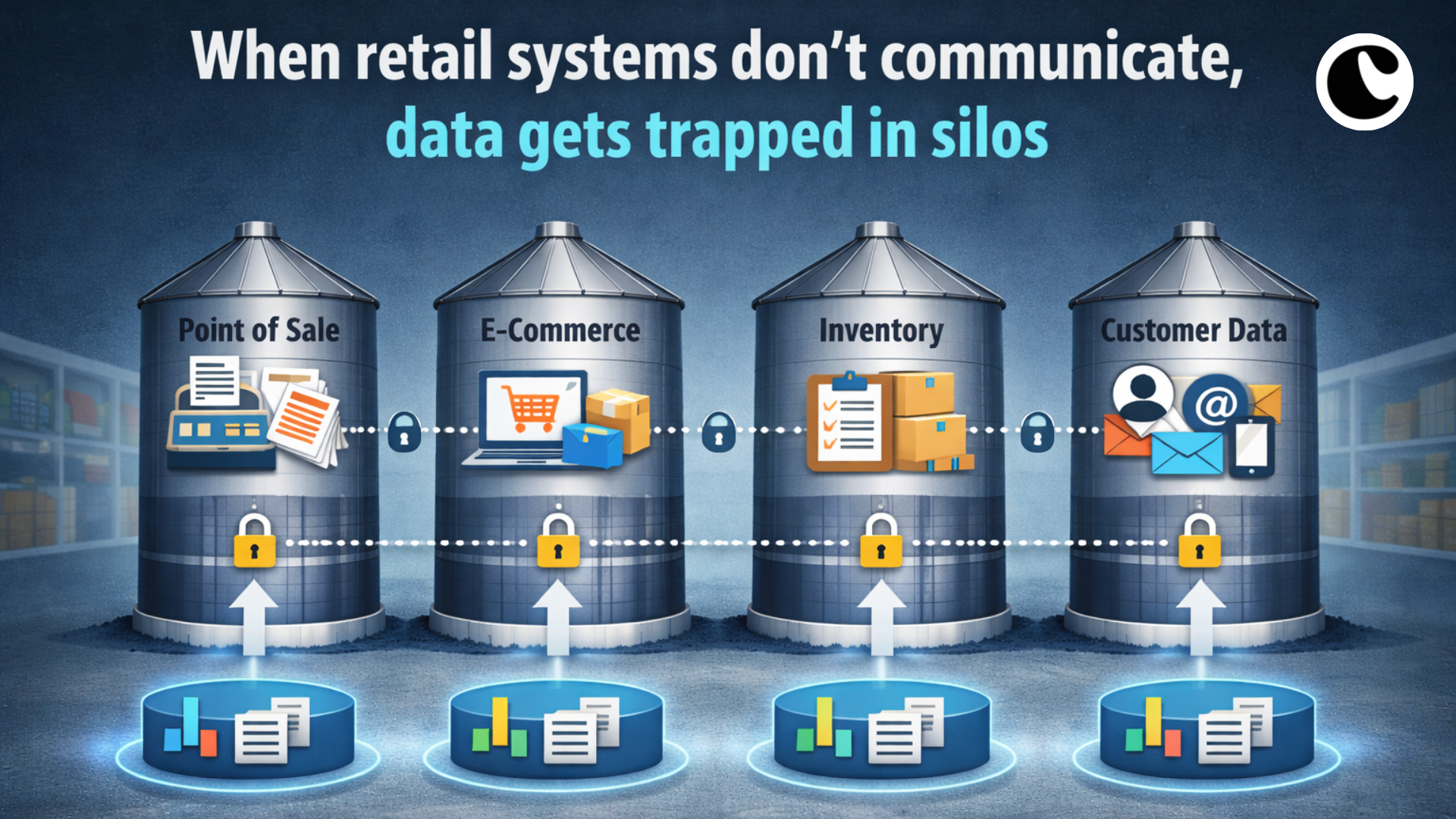
Let's get specific about the challenges.
When product information exists in multiple systems without synchronization, you get:
Your merchandising team decides how much of each product goes to which channel.
But if your ERP shows one inventory level, your marketplace integrations show another, and your PIM has product availability marked differently, how do you allocate accurately?
Allocation inefficiencies typically cost 2-4% of revenue in unnecessary logistics and missed sales.
Markdowns happen when products don't sell at full price.
Disconnected systems increase markdown risk in two ways:
| First | Second |
|---|---|
| Late product launches mean shorter full-price selling periods. Products that should sell for 12 weeks at full price only get 8 weeks because launch execution dragged. | Poor allocation based on stale data means products end up in the wrong channels. By the time you realize it, the selling window has closed. |
Enterprise organizations using integration platforms report average annual benefits of $3.45 million from improved data processing and automation, with payback periods around 4.2 months. Much of that value comes from reduced markdown rates.
New products generate the highest margins when they launch first.
But speed requires coordination. PLM needs to push specs to PIM immediately. PIM needs to sync with ERP for costing. ERP needs to feed marketplace listings with accurate pricing.
Manual handoffs between systems add 5-14 days to this process.
That's 5-14 days, your product isn't available. Days your competitors are capturing market share. Days of full-price selling opportunity lost forever.
Good retail operations management eliminates friction at four critical points:
Retail technology solutions are about connecting what you already have, so merchandising execution happens faster.
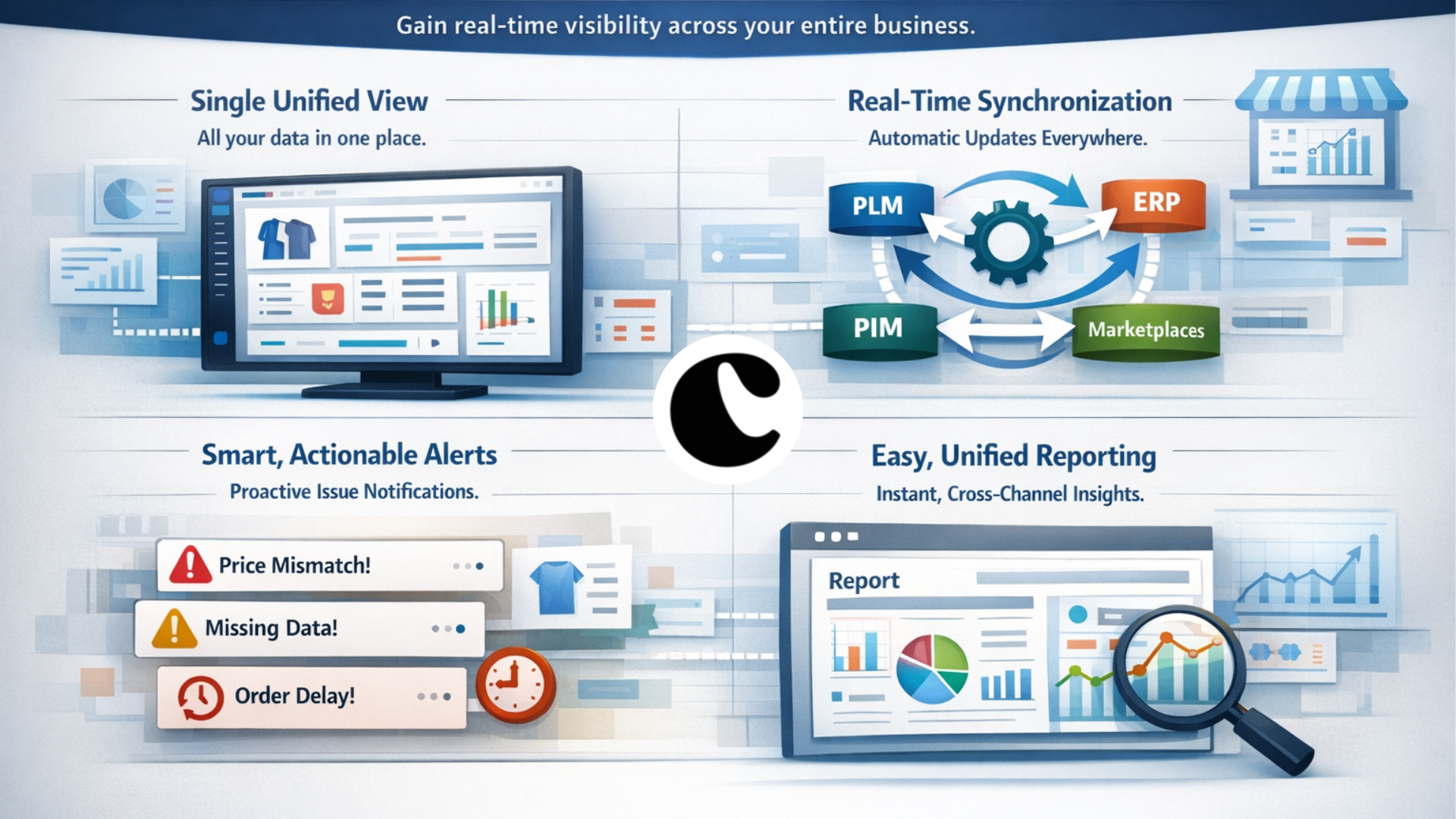
Retail automation in merchandising means eliminating manual tasks that slow down decisions and create errors.
Stop losing margin to manual reconciliation. If your team spends time syncing data between ERP, PLM, PIM, and marketplaces, Couture.ai can show you how connected retail technology solutions eliminate that friction.
Let's quantify what changes when merchandising execution accelerates.
Connected systems reduce time-to-market by 40-60%.
For retailers launching 100+ products annually, this improvement adds 5-8% to top-line revenue.
Average margin improvement: 2-4 percentage points.
For a $50M retailer, that's $1-2M in recovered margin annually.
These improvements free up working capital and reduce storage expenses.
Around 73% of customers expect companies to understand their individual needs. That's impossible when your teams spend time reconciling systems instead of analyzing customer behavior.
Enterprise organizations using integration platforms report average annual benefits of $3.45 million from improved data processing and automation. Payback periods average 4.2 months.
These are measured outcomes from retailers who eliminated system disconnection.
Your disconnected system is expensive.
Every day you run on disconnected platforms, you're wasting money. Losing time. Losing competitive advantage.
The fix isn't complicated. Connect your systems. Automate the repetitive stuff. Give your team better tools.
When you do that, everything else gets easier.
Your inventory becomes accurate. Your teams become efficient. Your customers become happier.
And your business grows faster.
Ready to stop wasting time on disconnected systems? Connect with Couture.ai to see how integrated retail operations management can work for your business. Let's explore what's possible together.
Subscribe to get the latest updates and trends in AI, automation, and intelligent solutions — directly in your inbox.
Stay Informed: Insights and Trends from Couture AI
Reduce operational complexity, improve planning accuracy, and deliver smarter retail execution with Couture AI.