Jan 20, 2026 | Couture AI Team
Your products are ready to launch. Your content isn't.
This is the problem breaking retail teams. Content at scale has become the biggest operational bottleneck between having inventory and making it shoppable online.
The speed of modern retail has completely changed. Launch cycles that used to take months now happen in weeks. But content creation? Stuck in the old timeline, built for a different era of retail.
The gap between product availability and catalog readiness continues to widen. And it's costing you sales.
When we talk about retail content production, we're talking about the visual infrastructure that makes products discoverable and shoppable:
Remember when a product listing meant three clean shots on a white background? That was enough to be competitive.
Not now.
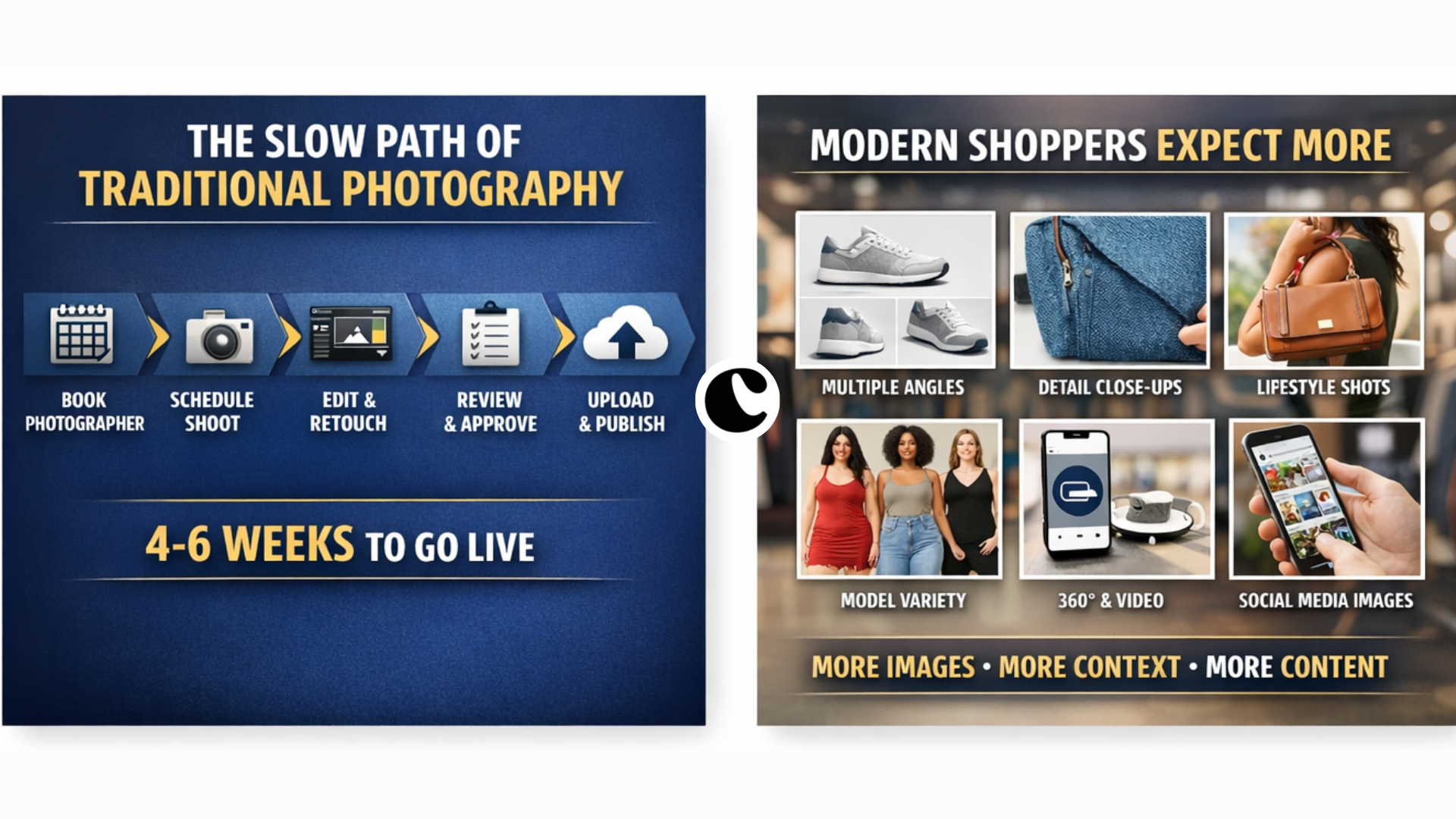
Today's minimum standard for a complete product listing includes hero product shots from multiple angles, material and construction close-ups showing quality indicators, lifestyle imagery demonstrating product usage and scale, on-model shots showing fit and proportion across multiple body types, variant imagery for every available colorway, and marketplace-optimized versions meeting platform-specific requirements.
Research shows that 96% of merchandising leaders report content demand has at least doubled over the past two years, with over 60% reporting 5× growth or more - with expectations of continued acceleration through 2027.
Your product exists as one physical item. But online, it needs to exist in dozens of visual formats.
The same handbag SKU requires marketplace catalog shots with clean white backgrounds and specific dimensions per platform guidelines. Amazon has different specs than Walmart. Target+ has different requirements than both.
It needs lifestyle contexts - the bag styled for work environments, weekend casual settings, evening use cases, and travel scenarios. Each context helps different customer segments visualize ownership.
It requires model diversity - the bag on different body types and heights to help shoppers understand scale and proportion. This isn't just inclusive, it's functionally necessary for accurate purchase decisions.
Seasonal variations matter too. Spring/summer styling with lighter contexts. Fall/winter presentations with appropriate seasonal relevance. Products that look seasonally current convert better than recycled imagery.

Fast fashion fundamentally changed consumer expectations about product availability and freshness.
Beauty brands launch limited editions with minimal lead time. Home goods retailers need to respond to trending aesthetics within weeks. Apparel companies release seasonal colorways to capture moment-specific demand.
Here's what that timeline pressure looks like:
Your buying team finalizes a new collection. Manufacturing delivers samples. Your inventory is warehouse-ready. Now the race begins to make it shoppable.
Traditional content creation means booking photographer availability (typically 2-3 weeks minimum), coordinating styling and models, executing the shoot day, processing files through editing and retouching, navigating review rounds and approval workflows, and final delivery and upload to all channels.
Best case scenario is looking at 4-6 weeks from product in hand to be fully represented across all selling channels.
Meanwhile, your inventory sits in the warehouse. Unsearchable. Unbuyable. Generating zero revenue.
Every merchandising team has seen this scenario:
Launch date is set. Inventory has arrived. Marketplace listings are staged. Everything's coordinated.
Except the product visuals aren't quite finished. Still waiting on final edits. One more approval round needed.
So you launch anyway. With placeholder images. With the only shots available. With incomplete visual coverage.
Customers find the listing. They see limited imagery. No lifestyle context. No model shots. No detail views. The listing feels unfinished, untrustworthy, and not ready for purchase.
They bounce. They buy from competitors with complete listings. Your inventory sits.
Baymard Institute research shows that product page issues - including inadequate or poor-quality visuals - are among the most frequent reasons customers abandon purchase decisions entirely.
You have inventory. You have a demand. But incomplete content creates an invisible barrier between the two.
Traditional photography is inherently sequential. One step must follow another. Each step consumes time. There's no way to compress the physics of getting people, products, and equipment coordinated in one location.
AI product photography eliminates the sequence.
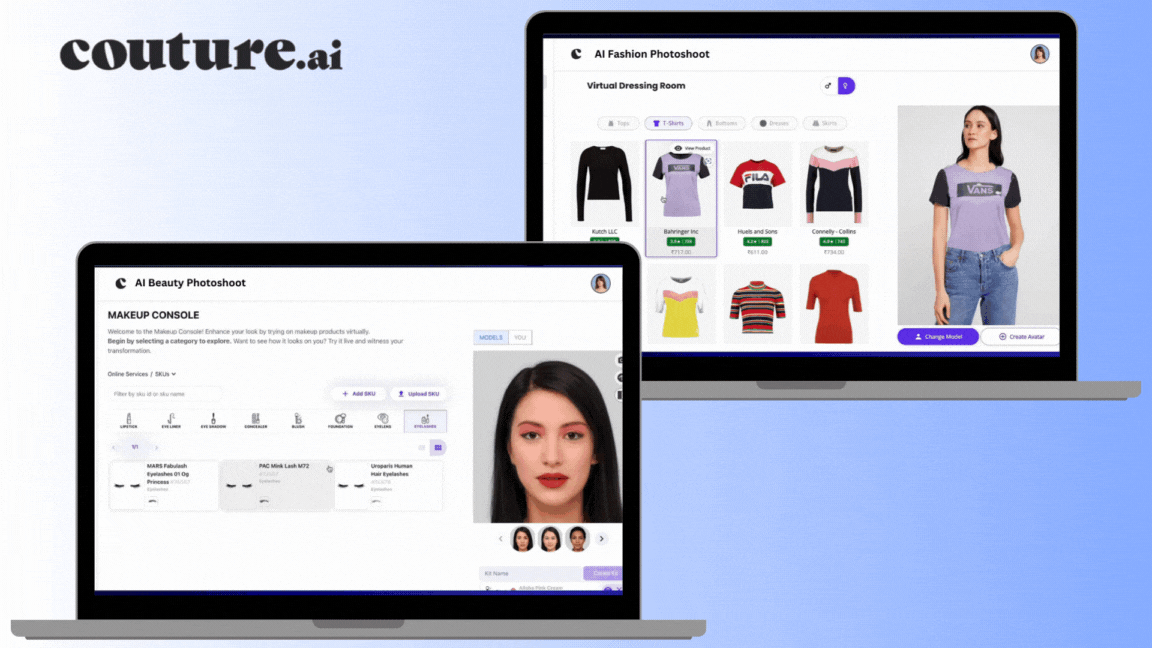
Upload your product image. Define the contexts needed. Generate the complete content set. Same day.
Do you need your handbag styled professionally? Generated. Now create a casual weekend context. Generated. Now produce a version optimized for warmer climate markets with brighter, outdoor settings. Generated.
Each of these variations previously required separate photoshoots. New coordination. New scheduling. New costs. New delays.
Now it's a parameter change.
When content takes weeks to produce, testing becomes impossible.
You make decisions upfront. Choose one background approach. Select one styling direction. Hope it performs well with your customer base.
If conversion underperforms? You're stuck with it. The budget is spent. The timeline has passed.
But when content at scale is generated in hours instead of weeks, systematic testing becomes operationally feasible.
Create five background variations. Launch them across segments. Analyze which drives higher conversion. Optimize toward what's working. Eliminate what isn't.
One footwear retailer tested urban environment backgrounds versus natural outdoor settings for their hiking boot category. The outdoor context converted 41% better. They immediately standardized that approach across the entire outdoor category.
That merchandising insight was only possible because producing test variations with AI product photoshoot solutions didn't require scheduling additional sessions or consuming more budget.
Shoppers compare your product pages against the best-in-class listings they encounter. If your visual content quality lags behind category leaders, they make assumptions about your product quality, too.
Current expectations for complete catalog coverage include visual diversity with multiple models representing different body types and ages. Customers need accurate visual information about fit, scale, and proportion.
Contextual variety shows products in multiple relevant use cases. A coffee maker in a modern minimalist kitchen, in a traditional warm breakfast space, and then in a compact office kitchen. Different contexts help different customer segments visualize ownership.
Seasonal currency matters. Summer products in summer-appropriate contexts. Winter products in seasonally relevant settings. Content that feels current signals new inventory, not old stock being liquidated.
Detail transparency through close-up shots reveals material quality, construction details, stitching, texture, and finish. Customers scrutinize every available visual detail before purchase.
Meeting these expectations through traditional photography means more shoots, larger budgets, and longer timelines. Most merchandising teams simply can't scale their existing approach to meet complete catalog coverage requirements.
The retail brands gaining market share right now have solved their content production bottleneck.
Every day a SKU lacks a complete visual representation is a day of suppressed conversion and lost sales. Every launch that misses its momentum window permanently underperforms its revenue potential.
Products with comprehensive visual e-commerce content convert 40-60% better than products with minimal or placeholder imagery. That's the difference between a profitable SKU and one that struggles to justify its inventory investment.
Time to market determines search visibility. Products that publish complete, high-quality content first capture top positions in marketplace search results. Products that publish later fight for page two visibility, where conversion rates drop dramatically.
When content production stops being a bottleneck, merchandising teams can operate differently.
Teams that previously spent 80% of their time coordinating logistics can redirect that capacity toward strategic work and performance optimization.
Instead of managing photographer schedules and studio availability, they're analyzing conversion data and optimizing content strategies based on performance.
Instead of rationing limited content budgets across priority SKUs while leaving long-tail products with minimal coverage, they're ensuring every SKU gets the visual representation needed to perform.
AI product photography scales differently than traditional approaches. Per-unit costs decrease as volume increases rather than compounding. Content budgets become predictable and manageable.
Every retail merchandising team faces this decision now:
Continue pushing traditional photography methods harder, or adopt production approaches that match modern retail velocity requirements.
Traditional photoshoots still serve specific functions. Brand campaign imagery. Editorial content. Hero photography that defines your brand aesthetic at the highest level.
But for the operational reality of catalog content? The hundreds or thousands of SKU images your e-commerce operation needs to maintain complete, current, competitive listings? That's where AI Photoshoot makes operational and financial sense.
Ready to see how this works for your catalog? Connect with our team at Couture.ai to explore what complete catalog coverage looks like for your assortment.
Subscribe to get the latest updates and trends in AI, automation, and intelligent solutions — directly in your inbox.
Stay Informed: Insights and Trends from Couture AI
Reduce operational complexity, improve planning accuracy, and deliver smarter retail execution with Couture AI.