Blog

Enterprise-Ready AI: Security, Governance & Control for Modern Merchandising

Dec 29, 2025 | Couture AI Team

Retail organizations are deploying AI retail solutions to refine merchandising decisions, but most are creating new vulnerabilities rather than solving existing problems.

Gartner predicts more than 40 % of AI-related data breaches will stem from misuse of AI, outpacing governance measures.

A single data breach now costs retailers an average of $3.48 million, up 18% year over year, with the industry representing about 6% of all data breaches worldwide.

According to IBM’s Cost of a Data Breach Report, the retail industry remains among the most expensive for data breaches, with prolonged containment times and heightened regulatory exposure driving total impact far beyond direct remediation costs.

Supplier Data Leaks
  • Merchandising team uploads supplier pricing data to an AI system
  • Three weeks later, that same pricing appears in a competitor's system
  • Main cause: Inadequate tenant isolation, allowing data cross-contamination

Multi-tenant architectures without strict data isolation are a documented source of cross-organizational data exposure, particularly in AI systems that reuse shared infrastructure and embeddings.

GDPR Compliance Failures
  • European customer requests data deletion under GDPR
  • AI vendor confirms removal, but data remains in model training sets and backup archives
  • Six months later, customer information surfaces in AI-generated recommendations
Black Box Decision-Making
  • Pricing algorithm recommends aggressive markups on certain products
  • The merchandising team can't explain the logic to leadership
  • They implement recommendations blindly because they can't see inside the model
Access Control Breakdown
  • Internal audit reveals 47 employees have full access to customer purchase histories
  • Access includes contractors who left the company months ago
  • No documentation of who accessed what data or when

The pattern repeats across retail organizations: security failures that look like isolated incidents are actually symptoms of deeper architectural problems. Access controls that depend on manual updates fail when employees change roles or leave. Audit systems that only log timestamps can't answer basic questions during investigations. Compliance documentation gets assembled reactively when auditors ask, rather than generated automatically by the system.

They're predictable outcomes when AI systems lack enterprise-grade security architecture.

Here's what breaks:

Weak Tenant Separation
  • Customer data from one retail organization contaminates another's environment
  • Shared infrastructure creates cross-contamination risks
  • No dedicated databases or isolation protocols
Manual Access Control Failures
  • Retail operations involve dozens of roles and hundreds of users
  • Constant turnover creates permission gaps immediately
  • Access persists long after employees leave
Missing Audit Infrastructure
  • Audit trails either don't exist or capture insufficient detail
  • During security investigations, basic questions go unanswered
  • Organizations can't determine what data was exposed or who accessed it
Compliance Theater
  • Vendors claim GDPR compliance or SOC 2 readiness without documentation
  • When auditors request proof, teams scramble to assemble evidence
  • Compliance becomes reactive instead of built into the architecture

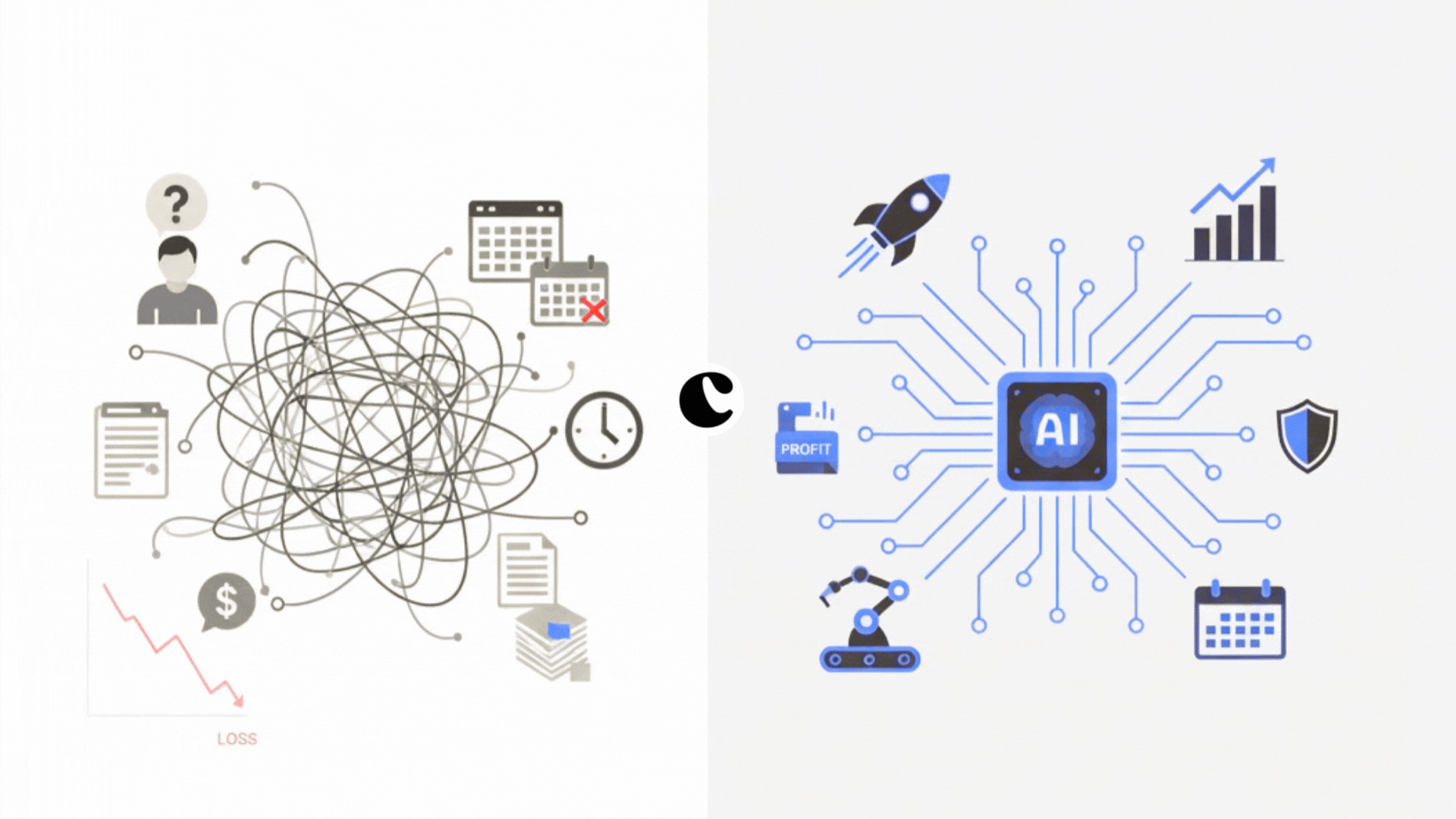
These systems were never designed to meet enterprise security requirements, handle regulatory compliance, or provide governance over business-critical decisions.

Image description

When retail organizations move to properly architected AI infrastructure, the operational changes are immediate and measurable. Merchandising teams shift from asking "Can we do this securely?" to simply doing their work - not because oversight disappeared, but because security became automatic rather than procedural. The friction between innovation and compliance dissolves when both are built into the architecture.

Here's what changes operationally:

When retail operations run on enterprise-ready AI retail solutions with proper security architecture, teams operate differently.

Merchandising Teams Stop Hesitating
  • Use AI insights for assortment planning without legal review delays
  • Trust pricing optimization recommendations consistently
  • Deploy demand forecasting with confidence
  • Security is verified through an independent audit
Access Management Becomes Automatic
  • Role-based permissions adjust as team members change positions
  • Employee departures trigger instant access removal
  • Contractors see only the project-specific data they require
  • Every access attempt generates detailed logs: who, what, when, why
Compliance Stops Being Reactive
  • GDPR compliant architecture ensures actual data deletion across all systems
  • Customer data removal happens in training data, active models, and backups
  • SOC 2 compliance provides independent verification of security controls
  • Audit documentation is instantly available, not manually assembled
Governance Makes Decisions Understandable
  • Merchandising teams see reasoning behind product line recommendations
  • Pricing suggestions show which factors drove specific markups
  • Assortment optimization reveals data sources influencing decisions
  • Control remains with humans while capturing AI benefits
Speed Increases Significantly
  • Security reviews drop from weeks to days through architectural guardrails
  • Merchandising teams test new strategies without approval bottlenecks
  • Assortment experiments proceed while maintaining compliance
  • Pricing adjustments happen faster with built-in security

Consider what happens to your security posture over time without proper infrastructure: In Q1, your merchandising team runs 50 AI-powered pricing analyses using customer purchase data. In Q2, they add assortment planning and demand forecasting - now 200 analyses monthly. By Q3, three more departments want access, and you're processing 500+ AI operations across customer data, supplier information, and competitive intelligence. Each analysis creates data artifacts: cached predictions, logged queries, and model training residuals. Each new user adds access points. Each integration expands your attack surface.

Meanwhile, the compliance landscape shifts beneath you. GDPR enforcement intensifies. A new state privacy law takes effect. Your auditor asks questions about AI explainability that weren't requirements last year. The contractor who built your initial AI integration left six months ago, but their access credentials still work. You're not managing one quarter's risk - you're managing accumulated, compounding exposure across four quarters of operations, eight data sources, 47 users with various permission levels, and compliance requirements that didn't exist when you started.

This is why delay doesn't just extend risk - it multiplies it:

Growing Threat Landscape
  • Data breaches are accelerating, not decreasing
  • Regulatory scrutiny intensifies globally
  • Financial exposure from inadequate AI security grows daily
The Hidden Liability
  • Merchandising teams see efficiency gains
  • Security teams see destructive exposure
  • Both perspectives are correct
  • Organizations carry risks they don't fully understand
Post-Breach Economics
  • Fixing security after a breach costs exponentially more than building correctly
  • Regulatory fines alone can reach tens of millions
  • Customer compensation and remediation expenses multiply
  • Reputation damage creates long-term revenue impact
  • Total cost dwarfs investment in enterprise-ready infrastructure
While organizations delay addressing security:
  • Competitors using properly secured AI move faster
  • They make better merchandising decisions consistently
  • They capture margin opportunities first
  • They build customer trust through transparent data practices
  • The performance gap widens every month

Retail organizations considering AI retail solutions need to verify security foundations before deployment:

Security Certification Verification
  • Confirm current SOC 2 compliance certification (Type II, not Type I)
  • Request actual audit reports, not marketing claims
  • Validate GDPR compliant architecture with documentation
Governance Testing
  • Test controls with real merchandising scenarios
  • Examine incident response capabilities
  • Ask specific questions about detection, containment, and recovery
Infrastructure Assessment
  • Review data isolation mechanisms
  • Evaluate access control automation
  • Verify audit trail completeness

Couture.ai approaches this differently. Our solutions are designed with SOC 2 Type II compliance, GDPR-compliant data handling, and automated governance as foundational architecture, not add-ons. Role-based access controls adjust automatically as your team changes. Audit trails capture the complete context across every merchandising decision.

Tenant isolation prevents data cross-contamination by design. And explainability is built into every recommendation - your team understands why the AI suggests what it does

Schedule a conversation with our team - we'll answer your specific questions about security, compliance, and how this translates to better merchandising outcomes.

The cost of delay compounds daily. The conversation costs nothing.

Stay Ahead with AI Insights.

Subscribe to get the latest updates and trends in AI, automation, and intelligent solutions — directly in your inbox.

Share with Your Network

Related Blogs

Stay Informed: Insights and Trends from Couture AI

Ready to Experience Autonomous Merchandising?

Reduce operational complexity, improve planning accuracy, and deliver smarter retail execution with Couture AI.


Get in Touch